



Multinational Study Co-Led by Precision-BTC-Network Members Highlights Critical Role of Early Matched Targeted Therapy in Advanced BTC
An international collaborative study published in the Journal of Hepatology has evaluated the delivery and clinical impact of matched targeted therapies following first-line chemoimmunotherapy in advanced biliary tract cancer (BTC). The research was co-led by Dr. Andrea Casadei Gardini (WG3 & WG5 member), Dr. Lorenza Rimassa (Management Committee & WG3 member), and Dr. Lorenzo Fornaro, with 11 additional Precision-BTC Network members contributing as co-authors. The Precision-BTC Network is proud to have supported this work by covering the Open Access publication costs.
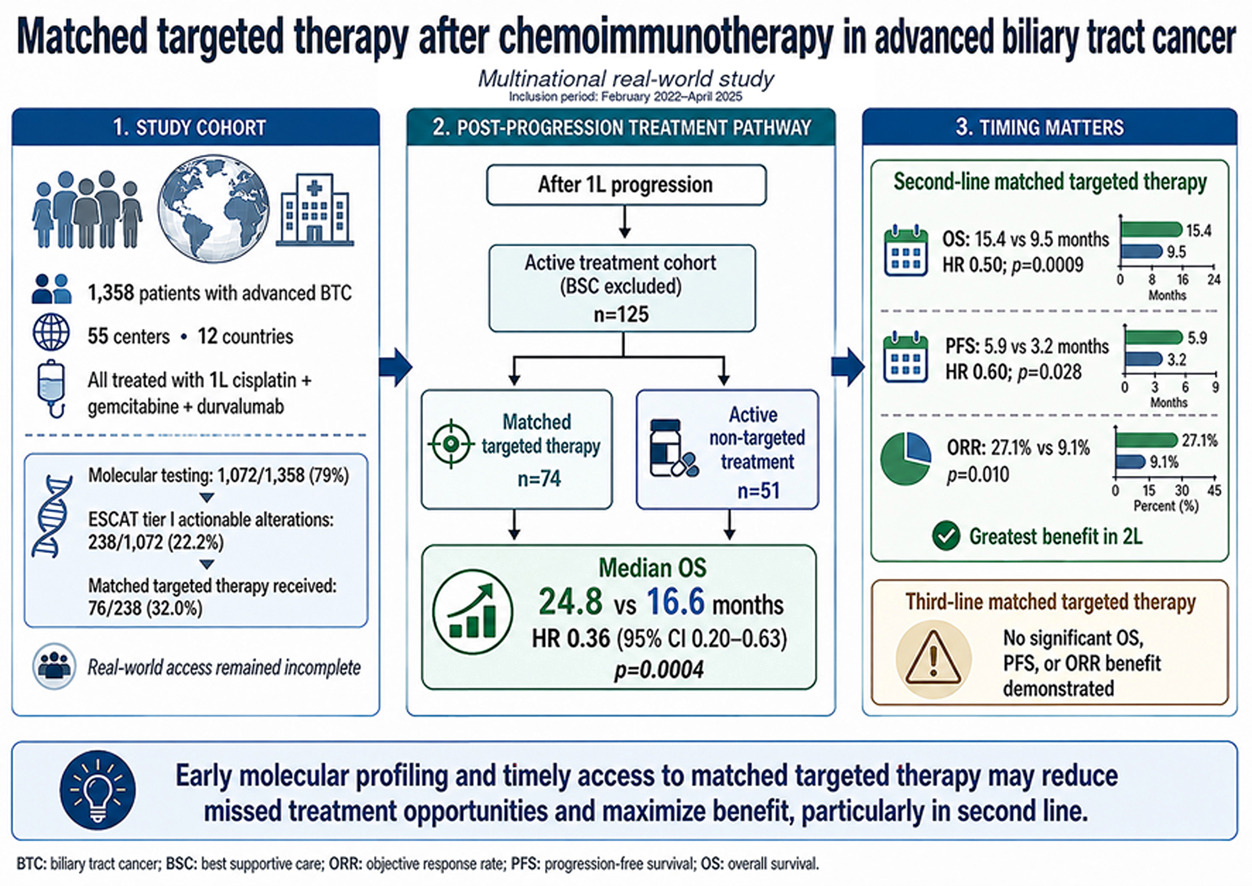
The multinational real-world study evaluated 1,358 patients treated with first-line cisplatin, gemcitabine, and durvalumab across 55 centers in 12 countries:
- Testing & Actionability: Molecular testing was performed in 1,072 patients (79%), identifying an ESMO ESCAT tier I actionable alteration in 238 patients (22.2%). However, only 76 of those 238 patients (32.0%) ultimately received matched targeted therapy, demonstrating that real-world access remains incomplete.
- Survival Benefit: Among patients receiving active treatment after first-line progression, matched targeted therapy was associated with substantially longer overall survival compared to active non-targeted treatment (median OS: 24.8 vs 16.6 months; HR 0.36; p=0.0004), an association that remained significant after multivariable adjustment.
- Timing Impact: In second-line treatment, matched targeted therapy yielded significant improvements in median overall survival (15.4 vs 9.5 months; HR 0.50), progression-free survival (PFS: 5.9 vs 3.2 months; HR 0.60), and objective response rate (ORR: 27.1% vs 9.1%). By contrast, no clear survival advantage was demonstrated when targeted therapy was delayed to third line.
The findings emphasize a clear clinical message: molecular profiling should be conducted early—ideally prior to first-line progression—to ensure actionable alterations are identified while patients remain fit enough to receive matched targeted therapies.
Header image source: Graphical Abstract, Casadei Gardini et al., Journal of Hepatology (2026) / Journal of Hepatology.